For OEMs/Genuine Makers in maritime and energy, make or buy has historically been a way to balance capital investment and part availability.
Today, that balance is shifting. OEMs are increasingly revisiting make-or-buy decisions as manufacturing technologies evolve and expectations around lifecycle support intensify. The debate is no longer about expanding traditional machining or casting capacity. It increasingly centers on whether to invest in "advanced" manufacturing and capital-intensive technologies to enable on-demand production – “make” – or to access those capabilities externally – “buy”.
Why is this question coming up now
Several factors are converging. Demand across OEM portfolios are becoming less predictable, especially for low-volume, high-mix, legacy portfolio parts that are difficult to plan around. At the same time, digital manufacturing technologies have matured to a point where they are no longer experimental but still require significant investment and specialist skills.
OEMs are also operating in more competitive service environments. Customers expect short lead times and consistent availability, while unauthorized manufacturing and grey market service providers are increasingly active in the aftermarket. Against this backdrop, manufacturing strategy is being re-examined not just as a cost question, but as a way to retain long-term control and protect revenue.
Why not just buy?
Buying external manufacturing capability offers clear advantages. It reduces capital investment, allows OEMs to access specialized technologies without committing to ownership, and provides flexibility as demand fluctuates.
However, buying is not without trade-offs. External manufacturing introduces dependency on supplier priorities and capacity allocation. Qualification, documentation, and audit requirements remain the OEM’s responsibility, regardless of where production takes place. For regulated industries, ensuring traceability, repeatability, and IP protection can require substantial governance effort. Some OEMs question whether reliance on external partners alone provides sufficient long-term control.
Related: Read about Pelagus' approach to quality and traceability
Why not just make?
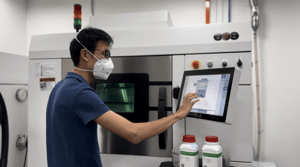
Building advanced manufacturing capabilities in-house can appear attractive. Internal systems give OEMs direct control over processes, data, and qualification pathways. They allow closer integration between engineering, manufacturing, and service teams, and can support faster response when lead time is critical.
The challenge lies in the scale of the investment. Advanced manufacturing systems are highly varied, and expensive to acquire and operate.
Utilization can be difficult to optimize when demand is fragmented, meaning OEMs risk periods of underuse for their machines. In addition, advanced manufacturing requires specialist skill sets that may not exist within the current organization. Building these capabilities internally means hiring new roles across engineering, digital manufacturing, qualification, alongside investment in training and data governance structures. Beyond cost, this can alter established ways of working and introduce organizational complexity as new capabilities are integrated into existing teams.
For many OEMs, the question is not whether they can build these capabilities, but whether doing so is economically and operationally viable.
An evolving consideration
In practice, most OEMs already operate hybrid manufacturing models, combining internal production with external sourcing. What is changing is the nature of the capabilities under discussion and the frequency with which the balance is reassessed.
This reflects an industry navigating operational and organizational change. OEMs look for ways to retain control, manage risk, and remain responsive in an increasingly complex manufacturing environment.
Is make or buy an active topic in your organization?
If you are currently reassessing manufacturing strategy, we welcome a direct conversation. Get in touch to discuss this in the context of your specific organization, and access exclusive make-or-buy resources.
Would you like to hear more?
To receive future insights, analysis, and discussions on manufacturing strategy in maritime and energy, join our mailing list.